
Wallace Carothers
American chemist who invented nylon and advanced polymer science.

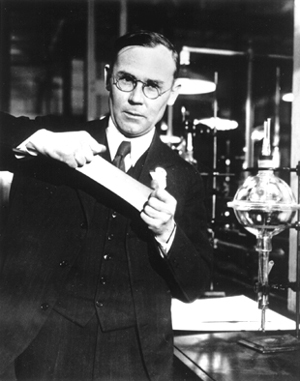
Wallace Hume Carothers was an American chemist, inventor, and the leader of organic chemistry at DuPont, credited with the invention of nylon. He also helped lay the groundwork for neoprene, the first synthetic rubber. Despite his professional success, Carothers struggled with depression throughout his life and died by suicide in 1937, before nylon was publicly announced.
- born
- April 27, 1896, Burlington, Iowa
- died
- April 29, 1937, Wilmington, Delaware
- field
- Organic chemistry, polymer chemistry
- nationality
- American
- known_for
- Invention of nylon, development of neoprene, Carothers equation
Lore & Background
Wallace Carothers was born on April 27, 1896, in Burlington, Iowa, the oldest of five children. He attended public school in Des Moines and, under pressure from his father, enrolled in Capital City Commercial College, completing an accountancy and secretarial curriculum in July 1915. He then entered Tarkio College in Missouri, initially majoring in English but switching to chemistry under Arthur Pardee. He graduated in 1920 with a bachelor of science degree, then earned a master of arts at the University of Illinois in 1921. After a year as an instructor at the University of South Dakota, he returned to Illinois for his Ph.D. under Roger Adams, awarded in 1924. He taught at Illinois and later at Harvard University before being recruited by DuPont in 1927 for its new fundamental research laboratory.
Reader's Guide
Carothers' significance lies in his pioneering work on polymers, which led to the invention of nylon and neoprene. At DuPont, he chose to study polymers, aiming to synthesize a polymer with a molecular weight exceeding 4,200. His team produced neoprene in 1930 and later a superpolyester with a molecular weight of about 12,000, which could be drawn into fibers. Carothers derived the Carothers equation, relating the degree of polymerization to monomer conversion, a foundational concept in step-growth polymerization. His work laid the theoretical and practical groundwork for the synthetic fiber industry. However, his legacy is also marked by his personal struggles: he suffered from depression, felt he had not accomplished much despite his success, and died by suicide in 1937, sixteen months before nylon was publicly announced. His daughter was born later that year.
Did You Know?
- Carothers kept a capsule of cyanide attached to his watch chain.
- He married Helen Sweetman on February 21, 1936.
- His daughter Jane was born on November 27, 1937, after his death.
- Carothers initially refused DuPont's job offer, citing 'neurotic spells of diminished capacity.'
From Iowa to the Laboratory: Academic Formation
Carothers grew up in Burlington, Iowa, the eldest of four children, and from a young age showed a deep fascination with tools and mechanical experimentation. His formal education began at public school in Des Moines, where he was recognized as a diligent student. Under his father's pressure, he first completed a commercial curriculum in accountancy and secretarial work at Capital City Commercial College in 1915. His true calling emerged at Tarkio College in Missouri, where chemistry professor Arthur Pardee redirected his studies from English to chemistry. His talent was immediate: before graduating, he was elevated to instructor status and took over the senior course when Pardee departed. He earned his B.S. in 1920, then pursued a master's at the University of Illinois under Carl Marvel. His independent research at the University of South Dakota produced a paper in the Journal of the American Chemical Society, where he demonstrated that diazobenzene-imide contained a linear three-nitrogen chain rather than a ring structure. Back at Illinois, he completed his Ph.D. under Roger Adams in 1924, earning the prestigious Carr Fellowship along the way, and spent two years teaching organic chemistry before moving to Harvard in 1926.
Purity Hall and the Polymer Gambit
In 1927, DuPont made the bold decision to fund pure, fundamental research unconnected to any immediate commercial product. Carothers was invited to lead the organic chemistry group at the new Experimental Station near Wilmington, Delaware. The transition was not easy: he initially declined the offer, confessing to suffering from neurotic spells of diminished capacity that he feared would be more damaging in an industrial setting. A DuPont executive, Hamilton Bradshaw, personally traveled to Harvard to persuade him otherwise. The financial incentive was significant—$500 monthly versus Harvard's $267. Carothers began work on February 6, 1928, choosing polymer research because it demanded theoretical exploration while carrying enormous commercial potential. His central ambition was to synthesize a polymer exceeding the 4,200 molecular weight benchmark set by Emil Fischer. By mid-1928 his team included several Ph.D. chemists and two consultants—his old advisors Adams and Marvel—and their workspace became colloquially known as Purity Hall. Yet by mid-1929 the group had not yet surpassed a molecular weight of roughly 4,000, a deeply discouraging plateau.
A Mind Under Pressure
Long before his professional triumphs, Carothers carried a persistent struggle with depression that he acknowledged openly. In a letter to his old Tarkio roommate Wilko Machetanz, he described accepting incalculable benefits proffered out of sheer magnanimity while failing to return even trivial courtesy, attributing his inertia to obtuseness, fear, selfishness, or mere indifference. This self-critical honesty reveals a man who measured his worth against an impossibly high internal standard. His unhappiness deepened in his final years. Despite what the world would later celebrate as one of the twentieth century's most consequential inventions, Carothers felt he had accomplished little and had exhausted his creative ideas. The death of his sister compounded his despair. He married Helen Sweetman on February 21, 1936, but the marriage offered no lasting solace. On April 28, 1937, just one day before his forty-first birthday, he ended his life by ingesting potassium cyanide. The tragedy is sharpened by timing: the public would not learn of nylon for another sixteen months.
The Nylon Paradox and Enduring Legacy
History credits Wallace Carothers as the inventor of nylon, yet he never lived to see the material announced to the public. His death on April 29, 1937, came sixteen months before DuPont revealed nylon on October 27, 1938. His daughter Jane was born on November 27, 1937, seven months after his passing—a life entering the world just as the world was about to be reshaped by the product of his mind. Beyond nylon, Carothers helped lay the scientific groundwork for neoprene, another polymer that would transform industries. At Harvard, president James B. Conant—himself a chemist—observed that Carothers displayed an extraordinary originality even in his early work, never content to follow conventional interpretations of organic reactions. His first thinking about polymerization and high-molecular-weight structures began during his Harvard years. He was initiated into the Alpha Chi Sigma chemistry fraternity in 1926. The irony of his legacy is profound: a man who believed he had run out of ideas and accomplished nothing was, in fact, responsible for materials that would permeate daily life for generations.
Gallery

Frequently Asked Questions
Who is Wallace Carothers?
Wallace Hume Carothers was an American organic chemist born in Burlington, Iowa, in 1896, who went on to lead DuPont's research division and became best known for creating nylon.
What did Wallace Carothers invent?
He is credited with developing nylon, the first fully synthetic fiber, and also played a key role in the early research that led to neoprene, the first synthetic rubber.
How did Wallace Carothers's story end?
Despite his groundbreaking achievements, Carothers battled depression for much of his adult life and took his own life in Wilmington, Delaware, in April 1937—just months before nylon was unveiled to the public.
What is the Carothers equation?
It is a formula in polymer chemistry that relates the number-average molecular weight of a polymer to the extent of reaction, and it remains a standard tool in the field.
Why is Wallace Carothers important to chemistry and engineering?
His work essentially launched the modern polymer industry, giving the world the first mass-produced synthetic fiber and establishing theoretical foundations that engineers and chemists still rely on today.
More in Inventors And Engineers 1-17
Spotted an error? Know more?
This is a living reference — every entry is fact-audited, and reader corrections feed straight into our audit queue. Suggest an edit · See this site's audit record